Omnichannel Brand Strategy Explained:
One Voice, Every Touchpoint
The person clients meet in your email should match the one on your LinkedIn. Here is how founders build omnichannel authority without brand whiplash.
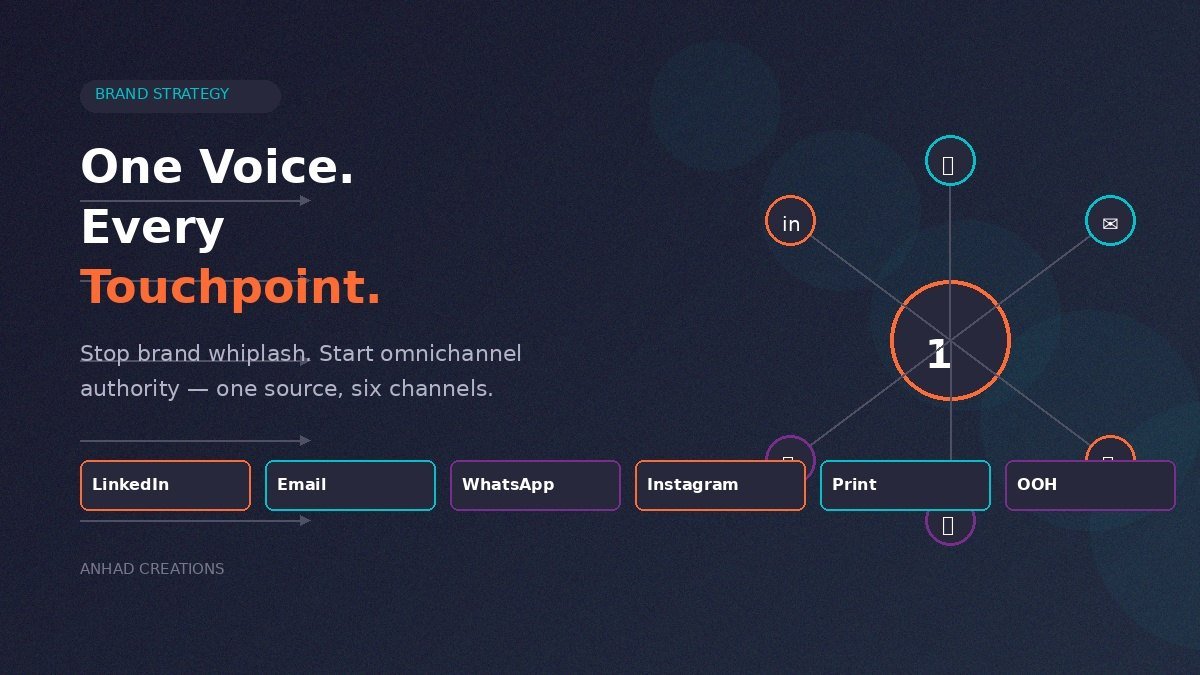
Your buyer does not live on one platform. They scroll LinkedIn on Monday, check WhatsApp at lunch, open your email on Wednesday, and walk past your billboard on Friday. If each of those touchpoints sounds like a different company, you have a problem.
Not a small problem. A trust-destroying problem.
We call it brand whiplash — the dissonance that happens when your LinkedIn sounds like a motivational speaker, your email sounds like a corporate newsletter, and your website sounds like a law firm. The person clients meet in your email does not match the one on your website. The founder on LinkedIn does not match the founder in the pitch deck.
For founders, brand whiplash is fatal. Because founders are the brand. Inconsistency is not a marketing error — it is a credibility wound.
What Omnichannel Brand Strategy Actually Means
Omnichannel is not about being everywhere. It is about being one thing everywhere. One voice. One narrative. One source of truth — deployed across every channel your buyers actually inhabit.
The mistake most founders make? They treat each channel as a separate content stream. LinkedIn gets a freelancer. Instagram gets an agency. Email gets an intern. WhatsApp gets ignored. Print gets whatever is left over. The result is five different versions of the same founder — none of them accurate.
True omnichannel strategy means:
- One core idea per month — extracted from the founder's thinking, not invented by a strategist
- One editorial team — writers, designers, and strategists who work as a unit, not silos
- One voice guide — vocabulary, sentence rhythm, story references, and tonal boundaries
- Channel-specific adaptation — same message, different format, never different message
See how the 4-Hour Model worksOne session a month, a month of authority across every channel.
ExploreThe Omnichannel Ecosystem: Where Founders Should Show Up
Not every channel deserves equal energy. Here is how we map the founder omnichannel ecosystem for B2B leaders in India:
LinkedIn Authority
Thought leadership that turns followers into high-ticket conversations. Long-form posts, contrarian takes, and case study breakdowns that position you as the expert in your space.
Primary ChannelEmail Strategy
Nurture sequences people genuinely look forward to opening. Deeper dives, insider frameworks, and personal stories that build relationship at scale.
Nurture LayerWhatsApp Concierge
High-touch updates for your most valuable, most exclusive circles. Private, intimate, and direct — the channel that turns contacts into insiders.
Inner CircleInstagram Presence
Visual storytelling that builds lifestyle authority and humanises the founder. Behind-the-scenes, team culture, and moments that show the person behind the position.
Humanise LayerPrint & Expo
Brochures to booths — a physical presence as sharp as your digital one. The channel that signals permanence and premium positioning.
Premium SignalOut-of-Home
Billboards and ambient media that carry the same voice as everything digital. For founders ready to own physical space in their market.
Market OwnershipThe Architecture: One Source, Every Channel
Here is how the Anhad Creations omnichannel engine works in practice:
One session. One transcript. One source of truth.
The magic is not in the number of channels. It is in the unity of origin. Every piece of content traces back to the same transcript, the same voice, the same narrative arc. The founder does not write six versions of the same idea. The editorial team adapts one idea six ways.
LinkedIn vs. Instagram for Business: Same Voice, Different Format
This is where most founders stumble. They think LinkedIn and Instagram require different personalities. They do not. They require different formats.
On LinkedIn, your voice is analytical, long-form, and professionally intimate. You share frameworks, challenge industry assumptions, and tell business stories with moral weight. The reader is in work mode. They want insight they can apply.
On Instagram, your voice is visual, immediate, and personally intimate. You show the human behind the company — the morning routine, the team celebration, the unfiltered reaction to a win. The viewer is in scroll mode. They want to feel connected.
The critical rule: both should feel unmistakably like the same person. If your LinkedIn voice is sharp and contrarian, your Instagram should not be generic motivational fluff. If your Instagram is warm and candid, your LinkedIn should not be robotic corporate-speak. The through-line is your personality — the format is just the container.
WhatsApp Marketing for Founders: The Private Channel
WhatsApp is the most underrated channel in founder marketing. Not because it lacks reach — India has 500+ million WhatsApp users — but because most founders treat it like a broadcast tool.
It is not. It is a concierge channel.
We advise founders to use WhatsApp for three things only:
- Insider updates: "Here is what we are building before anyone else knows."
- Personal invitations: "I am speaking at this event. Would love to see you there."
- Direct value: "I just read this book and thought of you. Here is the one insight that applies to your business."
WhatsApp is not for mass marketing. It is for relationship depth. The people on your WhatsApp list should feel like they have a direct line to you — because in a meaningful way, they do.
Why Consistent Brand Voice Is a Competitive Moat
In a crowded market, the founders who win are not the ones with the best product. They are the ones with the most recognisable voice.
Think about the founders you admire. You could probably identify their writing blindfolded. You know their pet phrases. You recognise their story structure. You anticipate their contrarian takes. That is not an accident. That is deliberate voice architecture.
For the founders we work with, we build a voice guide that includes:
- Signature phrases: The vocabulary that recurs across their content (e.g., "the founder's drain," "brand whiplash," "invisible authority")
- Story inventory: The 5–7 personal stories that illustrate their philosophy and get retold across channels
- Tonal boundaries: What they never say, how they handle disagreement, their stance on industry trends
- Sentence rhythm: Short punchy openings? Long analytical paragraphs? Rhetorical questions? We capture and replicate it.
This is what makes a founder unmistakable. Not louder. Not more frequent. Unmistakable.
The Anti-Fragmentation Playbook
If you are currently managing multiple freelancers or agencies for different channels, here is how to fix the fragmentation:
- Audit your current voice: Pull the last 10 posts from each channel. Do they sound like the same person? If not, you have brand whiplash.
- Create a single source of truth: Record a 60-minute conversation where you talk about your philosophy, your origin story, and your contrarian views. Transcribe it. This is your raw material.
- Consolidate execution: One editorial team. Not five. The team should include strategists, writers, and designers who collaborate daily — not contractors who never speak to each other.
- Adapt, don't rewrite: One core idea per month. LinkedIn gets the long-form version. Email gets the nurture sequence. Instagram gets the visual story. WhatsApp gets the personal note. Same idea, different depth.
- Review for coherence, not just quality: Before anything ships, ask: "Does this sound like me? Does it match what we published last week? Will someone who follows me on three channels feel continuity?"
From Fragmented to Foundational
The founders who build legendary brands are not the ones who shout the loudest. They are the ones who show up as one person — everywhere their buyers look.
Omnichannel brand strategy is not a marketing tactic. It is a trust architecture. When your LinkedIn, email, WhatsApp, Instagram, print, and out-of-home all carry the same voice, you stop being a company people consider. You become a founder people believe.
That is the difference between fragmented presence and unignorable authority.
If you are ready to unify your brand narrative — one source of truth, deployed everywhere — book a strategy session. We will audit your current channels, identify the whiplash, and map your first month of coherent, omnichannel presence.